QG-LaDA: Reconstructing Quasi-Geostrophic Streamfunction from Lagrangian Drifters
Q G-L A D A:
Quasi-Geostrophic Lagrangian Assimilation of Drifter Abservations
MSc Thesis · University of Calgary · 2025
1 Schulich School of Engineering, University of Calgary
Advisor: Mustafa Mohamad
Poster
Video
TL;DR
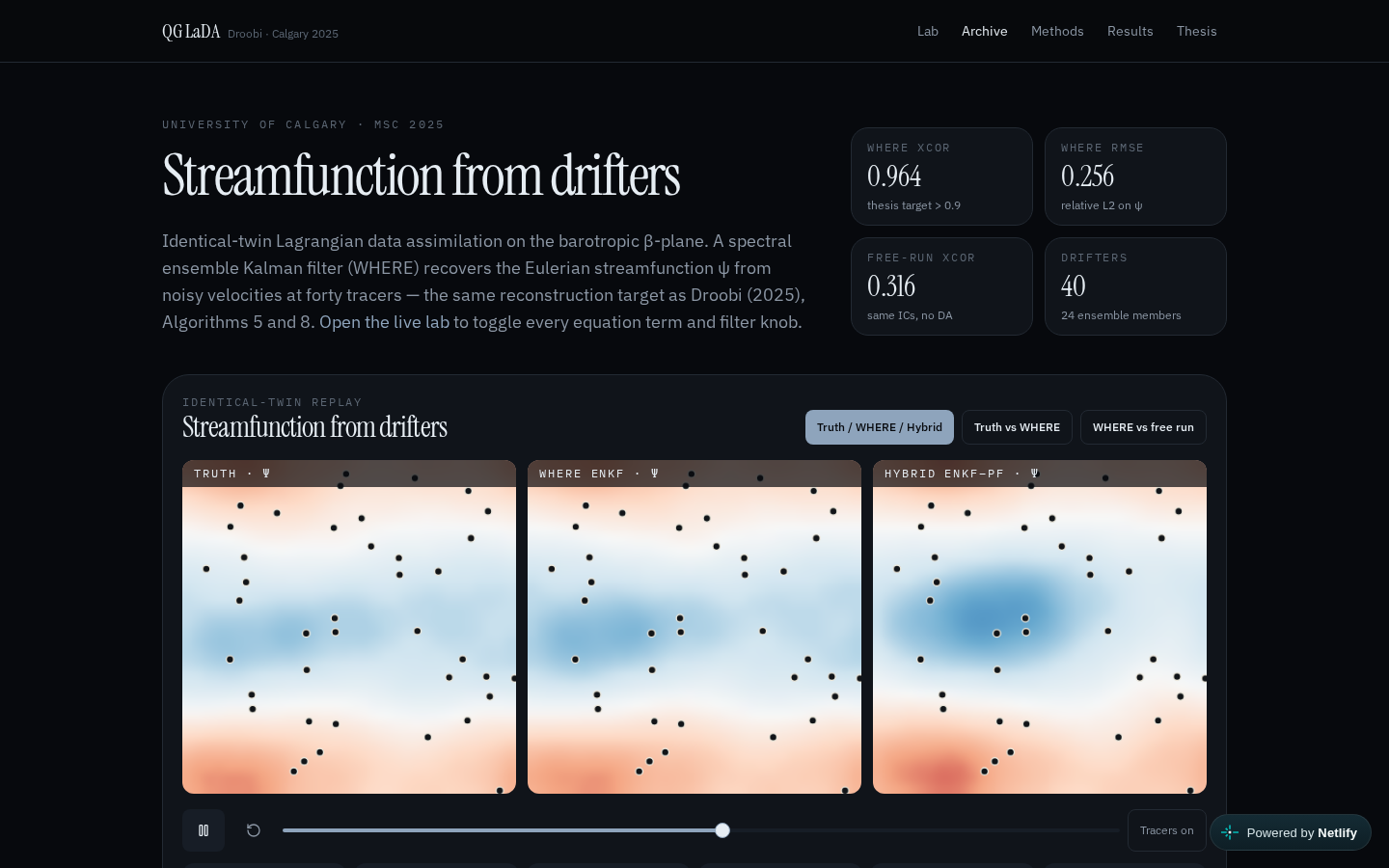
- Public identical-twin lab that recovers an Eulerian streamfunction $\psi$ from noisy Lagrangian velocities at 40 drifters.
- Spectral barotropic QG twin plus a localized stochastic EnKF (WHERE, thesis Algorithm 5), with an optional hybrid EnKF–PF branch (Algorithms 8–9).
- Helmholtz inversion $\hat{\psi} = -\hat{q}/(\kappa^2 + \mu)$; every PDE term and filter knob is live in the browser.
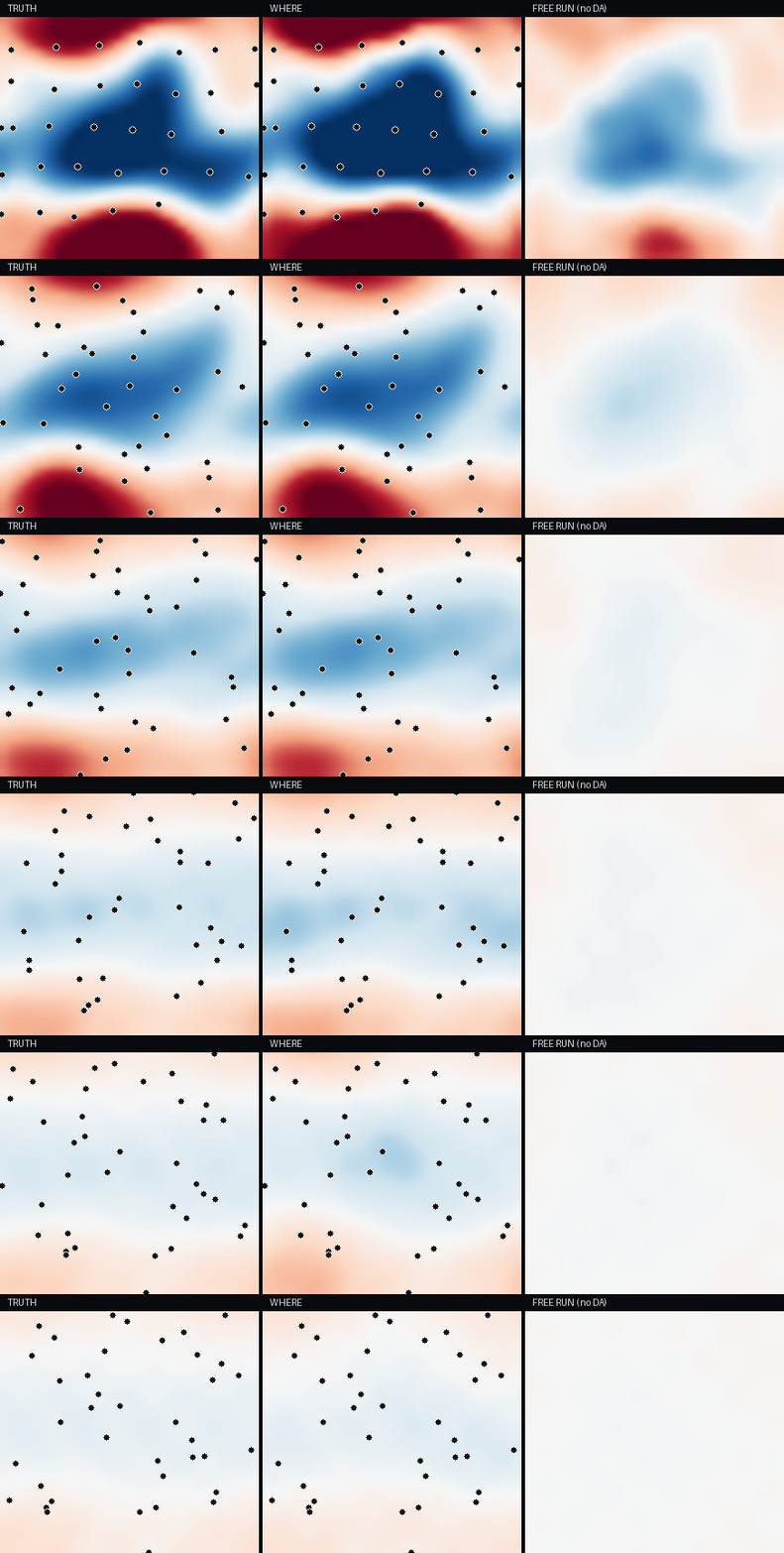
- Committed $N=32$ Python run: WHERE XCOR 0.964 vs free-run 0.316. Demo-scale, not thesis Table 10.1.
Abstract
This work contributes to the understanding of high-dimensional fluid flows, focusing on quasi-geostrophic systems, by reconstructing turbulent flow fields from a partial, noisy, time-sequential set of tracer measurements. Lagrangian drifters stream local velocity rather than a gridded streamfunction; the inverse problem is to recover $\psi$ from those tracks. A spectral quasi-geostrophic twin generates truth and a forecast ensemble. Helmholtz inversion maps vorticity to streamfunction. A localized stochastic Ensemble Kalman Filter (WHERE) assimilates the noisy velocities, with an optional hybrid EnKF–particle-filter branch. The public lab is a runnable companion to the University of Calgary MSc thesis Data-driven filtering techniques for turbulent flow models (a Lagrangian data assimilation approach) (Droobi, 2025).
Method
1. Initialization
A spectral barotropic QG model on a periodic $[0, 2\pi]^2$ $\beta$-plane produces the truth and the forecast ensemble. Forty drifters sit on a jittered lattice and observe noisy velocities ($\sigma_o = 0.04$). Streamfunction is recovered from vorticity by Helmholtz inversion.
2. Localized analysis
WHERE is a stochastic EnKF on vorticity. Predicted velocities at the truth tracer sites form the observation operator. Gaspari–Cohn localization ($L_{\mathrm{loc}} = 1.55$) tapers the sample covariances; multiplicative inflation $\alpha = 1.08$ keeps the ensemble from collapsing. Analysis interval is $0.35$ time units on the committed run ($N_e = 24$).
3. Hybrid refinement
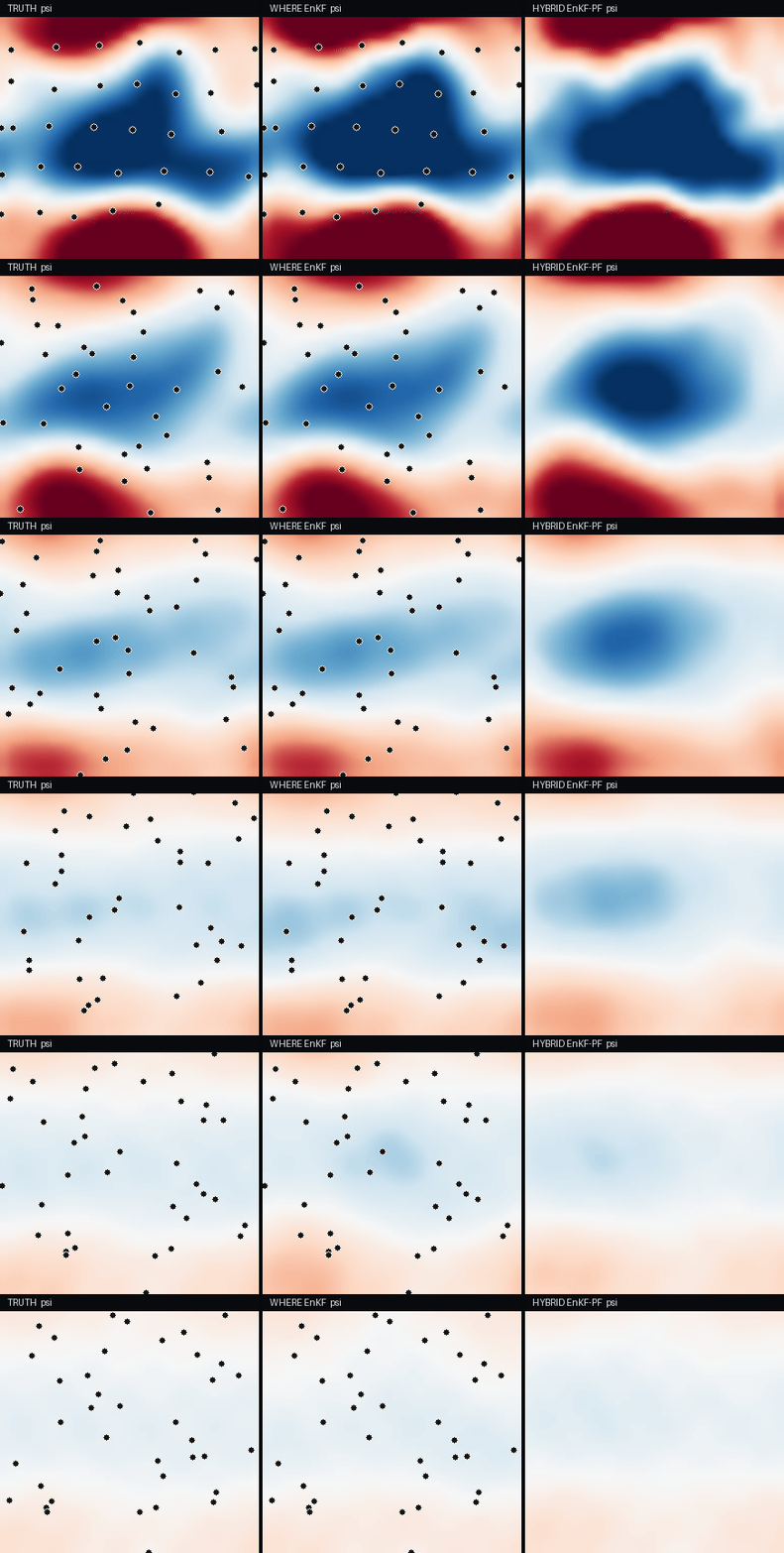
After the EnKF update, members can be reweighted by the Gaussian velocity likelihood and resampled when the effective sample size drops below $0.55\,N_e$. A $1.5\%$ jitter restores sample covariance after cloning. On this QG twin the hybrid matches large-scale correlation but does not beat WHERE on RMSE.
Results
Committed identical-twin Python run, $N = 32$, $N_e = 24$, $40$ tracers, $t_{\mathrm{end}} = 28$. Not a production forecast score and not thesis Table 10.1 (different resolution and horizon).
| Filter | XCOR | RMSE | Note |
|---|---|---|---|
| WHERE EnKF | 0.964 | 0.256 | clears XCOR target > 0.9 |
| Hybrid EnKF–PF | 0.945 | 0.367 | smoother; worse small-scale RMSE |
| Free run (no DA) | 0.316 | 0.960 | phase lost within a few eddy turnovers |
BibTeX
@mastersthesis{droobi2025lada,
  title   = {Data-Driven Filtering Techniques for Turbulent Flow Models
             (A Lagrangian Data Assimilation Approach)},
  author  = {Droobi, Ahmad},
  school  = {University of Calgary},
  year    = {2025},
  doi     = {10.11575/PRISM/49934},
  url     = {https://hdl.handle.net/1880/122341}
}